
 Image 1 of 1
Limited edition letterpress print
Botanical gardens were not always simply places to wander among beautiful plants.
They were places of experiment.
That became particularly clear to me when I encountered Erythroxylum Coca while researching Walter Hill, Brisbane’s first colonial botanist.
Native to South America, the plant is now best known as the botanical source of cocaine. But Hill cultivated Erythroxylum Coca in the Brisbane Botanic Gardens for its medicinal properties and as a possible substitute for tea, coffee, tobacco and opium.
I found that fascinating.
Here was a plant being grown not simply to observe it, but to discover what it might do.
The Gardens became a kind of living laboratory—a place where plants from different parts of the world were propagated, tested and considered for the roles they might play in a developing colony.
I began with the plant itself.
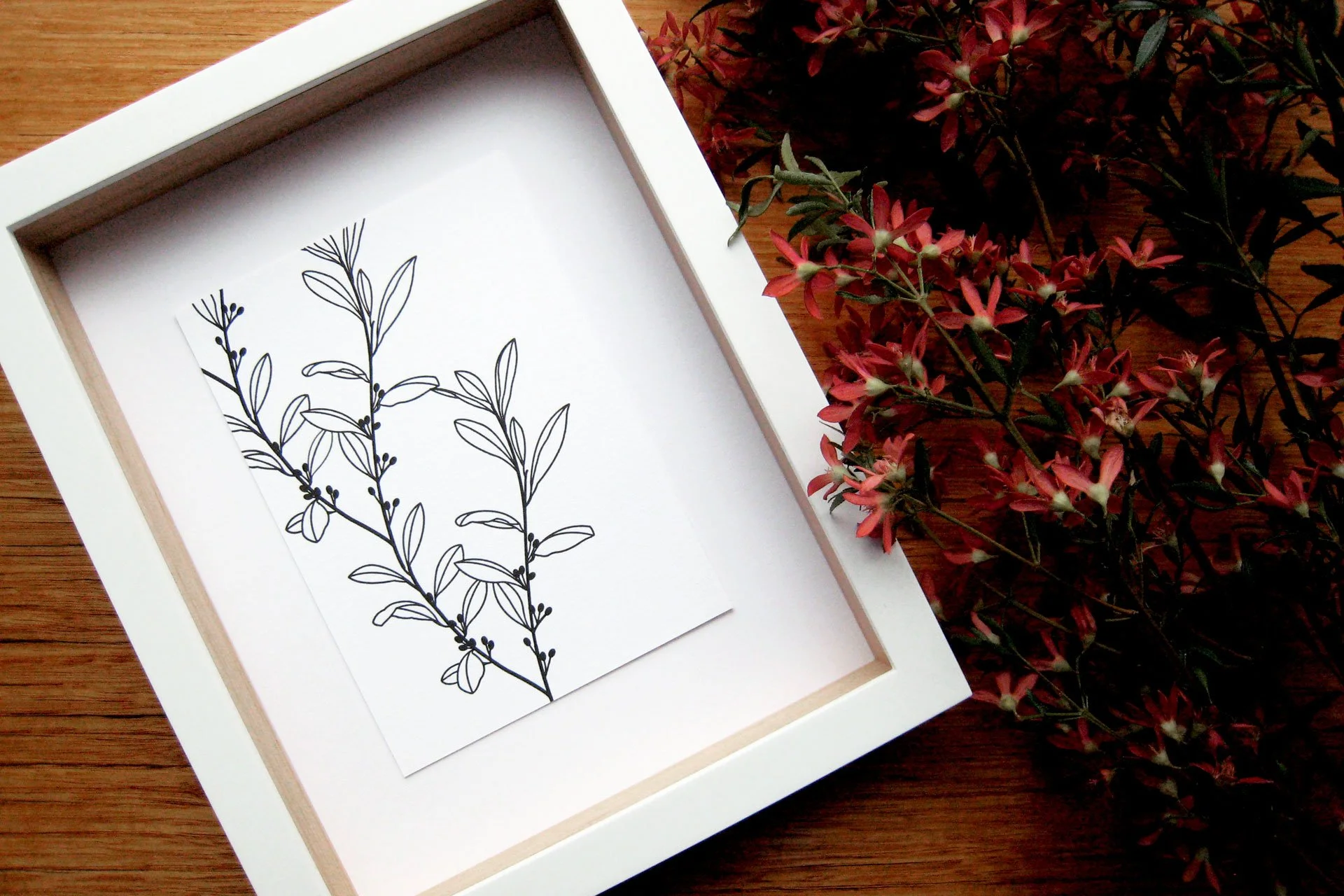
Its leaves and branching stems were extracted from botanical imagery and reorganised through repetition, allowing a plant carrying such a complex history to become something unexpectedly quiet and ordered.
I printed Erythroxylum Coca on an original Heidelberg Windmill letterpress, adding another meeting of past and present to the work.
There is something intriguing about knowing what lies behind the image.
At first, you see a pattern.
Then you discover the plant.
And suddenly the pattern carries an entirely different story.
The Edition
Released in an edition of twenty, Erythroxylum Coca is letterpress printed on Magnani Incisioni 650/5 Smooth White 100% cotton rag paper using rubber-based inks.
Each print is signed, titled and individually numbered on the reverse, wrapped in acid-free tissue and presented in a custom protective envelope. It is accompanied by information detailing the artwork, the Collected Patterns series and its place within the edition.
The print is sold unframed and ships worldwide in a rigid protective envelope.
Edition: 20
Paper size: 147 × 105 mm
Paper: Magnani Incisioni 650/5 Smooth White, 100% cotton rag
Printing: Letterpress with rubber-based inks
Press: Heidelberg Windmill
Signed: Signed, titled and numbered on reverse
Framing: Unframed
Shipping: Worldwide
Limited edition letterpress print
Botanical gardens were not always simply places to wander among beautiful plants.
They were places of experiment.
That became particularly clear to me when I encountered Erythroxylum Coca while researching Walter Hill, Brisbane’s first colonial botanist.
Native to South America, the plant is now best known as the botanical source of cocaine. But Hill cultivated Erythroxylum Coca in the Brisbane Botanic Gardens for its medicinal properties and as a possible substitute for tea, coffee, tobacco and opium.
I found that fascinating.
Here was a plant being grown not simply to observe it, but to discover what it might do.
The Gardens became a kind of living laboratory—a place where plants from different parts of the world were propagated, tested and considered for the roles they might play in a developing colony.
I began with the plant itself.
Its leaves and branching stems were extracted from botanical imagery and reorganised through repetition, allowing a plant carrying such a complex history to become something unexpectedly quiet and ordered.
I printed Erythroxylum Coca on an original Heidelberg Windmill letterpress, adding another meeting of past and present to the work.
There is something intriguing about knowing what lies behind the image.
At first, you see a pattern.
Then you discover the plant.
And suddenly the pattern carries an entirely different story.
The Edition
Released in an edition of twenty, Erythroxylum Coca is letterpress printed on Magnani Incisioni 650/5 Smooth White 100% cotton rag paper using rubber-based inks.
Each print is signed, titled and individually numbered on the reverse, wrapped in acid-free tissue and presented in a custom protective envelope. It is accompanied by information detailing the artwork, the Collected Patterns series and its place within the edition.
The print is sold unframed and ships worldwide in a rigid protective envelope.
Edition: 20
Paper size: 147 × 105 mm
Paper: Magnani Incisioni 650/5 Smooth White, 100% cotton rag
Printing: Letterpress with rubber-based inks
Press: Heidelberg Windmill
Signed: Signed, titled and numbered on reverse
Framing: Unframed
Shipping: Worldwide